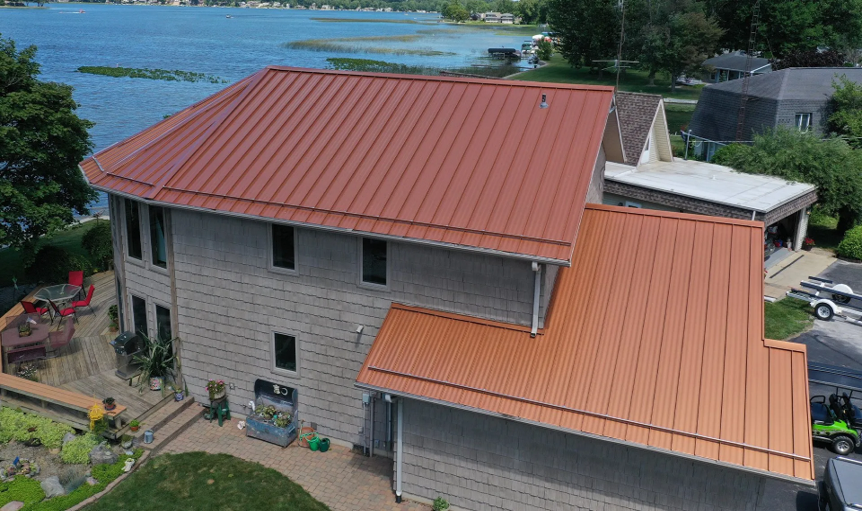
The Common Metal Roof Gauges
A few gauges are common in roofing, and knowing them helps a Clarks Hill homeowner compare options. Here are the main ones.
24 Gauge
24 gauge is the heaviest of the common roofing gauges, the thickest and most durable, offering the best dent resistance and rigidity. It is often used for standing seam and higher-end metal roofs where durability and a premium result are priorities. As the thickest common gauge, 24 costs more but provides the most robust panel. For a homeowner wanting the most durable metal roof, 24 gauge is the choice. It is the premium, heavy-duty option.
26 Gauge
26 gauge is a common middle choice, thinner than 24 but thicker than 29, offering a balance of durability and cost. It is widely used on residential metal roofs, providing good performance at a more moderate price than 24 gauge. As a middle-ground option, 26 gauge suits many homes well, balancing substance and affordability. For a homeowner wanting solid performance without the cost of 24 gauge, 26 is a frequent choice. It is a sensible balance.
29 Gauge
29 gauge is the lightest of the common roofing gauges, the thinnest and most economical, often used on outbuildings, agricultural structures, and budget-conscious projects. While less durable and dent-resistant than heavier gauges, it still provides a serviceable metal roof at the lowest cost. For utility buildings and tight budgets, 29 gauge is a practical, economical choice. It is the budget-friendly, lighter option. It suits the right applications well.
Comparing the Gauges
Across the three, the pattern is clear, 24 gauge is the thickest, most durable, and most expensive, 29 gauge is the thinnest, least expensive, and least durable, and 26 gauge sits in between. Each suits different applications and priorities, from premium residential to budget agricultural. Comparing them comes down to weighing durability against cost for your project. The gauges form a clear range from heavy-duty to economical. The right one depends on your needs.
Other Considerations
Beyond these common gauges, the metal type and finish also matter, and a contractor can advise on the right combination for your project. Gauge is one important specification among several. Considering gauge alongside the metal and finish gives the full picture. A knowledgeable contractor helps you choose the gauge and overall panel that fit your needs. The choice is part of a larger set of decisions. It works with the others.
The Common Gauges, in Short
24 gauge is the thickest, most durable, and most expensive, often for standing seam and premium roofs, 26 gauge is a common residential middle choice balancing durability and cost, and 29 gauge is the thinnest and most economical, common on outbuildings.
One point worth clarifying for Clarks Hill homeowners is the counterintuitive nature of the gauge scale, because it trips up almost everyone at first and is essential to getting the choice right. Gauge measures the thickness of the metal panels, but the numbering runs backward from what intuition suggests, a lower number means a thicker, heavier panel, not a thinner one. So 24 gauge is thicker and more substantial than 26 gauge, which in turn is thicker than 29 gauge. Once you internalize that smaller numbers mean more metal, the rest of the gauge decision becomes much clearer. The reason gauge matters is that the thickness of the metal has real, practical effects on how the roof performs and what it costs. A thicker, lower-gauge panel is more durable and rigid, and importantly, it resists denting from impacts like hail better than a thinner panel, which is why heavier gauges are favored for premium roofs and in hail-prone areas. The trade-off is cost, since a thicker panel uses more metal and therefore costs more, so 24 gauge is more expensive than 26, which is more expensive than 29. This sets up the basic decision a homeowner faces, balancing how much durability and dent resistance they want against how much they are willing to spend, in light of what the roof is going on. A premium home or a standing seam roof typically justifies a heavier gauge, a general residential roof is often well served by a middle gauge like 26, and a utility building like a barn or shed can use a lighter, more economical gauge like 29. A knowledgeable contractor can help match the gauge to your specific application, conditions, and budget.
It also helps Clarks Hill homeowners to understand that gauge, while important, is one of several specifications that together define a metal roof panel, and the best decisions consider them as a set rather than fixating on gauge alone. Alongside gauge, the metal type matters a great deal, since different metals have different inherent strength and characteristics, a given gauge of steel and the same gauge of a softer metal will not behave identically, and the choice between steel, aluminum, and the premium metals affects durability, corrosion resistance, weight, and cost in ways that interact with the gauge decision. The finish matters too, both for appearance and for the protection and longevity it adds, with quality finishes holding color and protecting the metal for decades. And the panel style, standing seam versus an exposed-fastener profile, interacts with the gauge choice, since premium standing seam systems are commonly paired with heavier gauges while economical exposed-fastener panels on utility buildings often use lighter ones. The practical implication is that when a homeowner is choosing a metal roof, the sensible approach is to work with a contractor who can advise on the whole package, the right gauge for the durability and dent resistance the situation calls for, the right metal for the conditions and budget, the right finish for appearance and protection, and the right style for the building and aesthetic. Gauge is a meaningful part of that picture and worth understanding, but it works together with the other specifications to determine the roof's overall performance, appearance, longevity, and cost, so considering them together leads to the best result for the home.
One point worth clarifying for Clarks Hill homeowners is the counterintuitive nature of the gauge scale, because it trips up almost everyone at first and is essential to getting the choice right. Gauge measures the thickness of the metal panels, but the numbering runs backward from what intuition suggests, a lower number means a thicker, heavier panel, not a thinner one. So 24 gauge is thicker and more substantial than 26 gauge, which in turn is thicker than 29 gauge. Once you internalize that smaller numbers mean more metal, the rest of the gauge decision becomes much clearer. The reason gauge matters is that the thickness of the metal has real, practical effects on how the roof performs and what it costs. A thicker, lower-gauge panel is more durable and rigid, and importantly, it resists denting from impacts like hail better than a thinner panel, which is why heavier gauges are favored for premium roofs and in hail-prone areas. The trade-off is cost, since a thicker panel uses more metal and therefore costs more, so 24 gauge is more expensive than 26, which is more expensive than 29. This sets up the basic decision a homeowner faces, balancing how much durability and dent resistance they want against how much they are willing to spend, in light of what the roof is going on. A premium home or a standing seam roof typically justifies a heavier gauge, a general residential roof is often well served by a middle gauge like 26, and a utility building like a barn or shed can use a lighter, more economical gauge like 29. A knowledgeable contractor can help match the gauge to your specific application, conditions, and budget.
Find the Right Gauge
Clarks Hill Metal Roofing installs metal roofing in 24, 26, and 29 gauge across Clarks Hill and Tippecanoe County, matching the gauge to the project. Call (765) 676-3491 for a free consultation on the right gauge for your home or building.